|
|
|
|
|
|
|
|
Multi Channel Flaw Detector for Automatic Ultrasonic Testing
Core component for automatic ultrasonic inspection systems
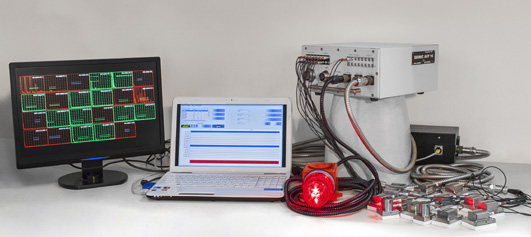
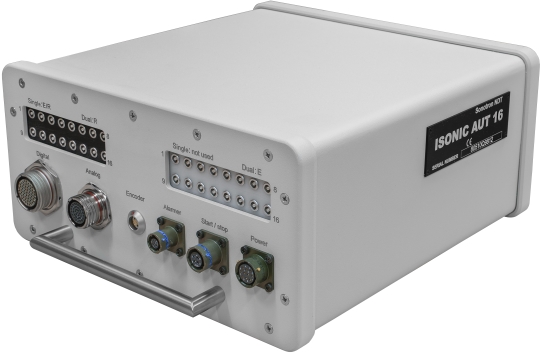
ISONIC AUT 16/32 portable instruments are built to serve as core components of in-line production and in-service automatic ultrasonic inspection systems.
ISONIC AUT 16 comprises 16 and ISONIC AUT 32 comprises 32 identical independent UDS 3-6 channels, each equipped with own pulser, receiver, and 100 MHz sampling rate signal digitizer (A/D Converter).
Every channel may drive either single or dual element probe or probe pair through 2 probe terminals. Highest scanning speed is achieved through simultaneous (parallel)
pulsing, receiving, digitizing, and recording of signals by up to 16 / 32 channels. On case of ultrasonic cross-talking UDS 3-6 channels may be toggled to work sequentially.
Significant improvement of signal to noise ratio and dynamic range is achieved through firing probes with unique bi-polar square wave initial pulse reaching up to 400 Volt peak-to-peak amplitude. Duration and amplitude
for both positive and negative half-waves of the initial pulse may be tuned in wide range. Further it is provided high stability of firing amplitude selected by an operator while leading and falling edges of bi-polar initial pulse are
electronically boosted.
Every channel is featured with 3 independent gates providing unique ability of Gain per Gate Adjustment (GGA) – this allows implementing of back echo attenuation, interface gate synchronizing, suppression of large geometry echoes, and other
functions typical for automatic ultrasonic inspection.
ISONIC AUT 16/32 electronics is featured with:
- multi-axis encoder interface
- scanner motor control and powering interface
- pedal and/or button “start/stop inspection” inputs
- programmable outputs for driving paint guns, audible alarm sirens, GO/NO-GO parts sorters
- signal TOF / amplitude proportional analogue outputs
The appropriate terminals may be arranged for all above external devices or any combination of them according to scope of inspection requirements.
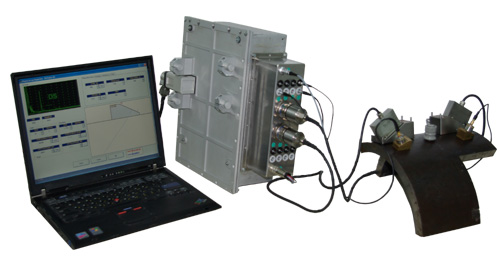
ISONIC AUT 16/32 instruments are packed into rugged portable and light IP 67 sealed cases, which may be either fitted onto the scanner’s chassis or mounted into a cabinet at the
stationary inspection deck or just dropped onto a ground while performing inspection at the filed site. Regular remote laptop or desktop PC equipped with inspection software package provides full
control of the instrument and real time data acquisition through Ethernet. Ultrasonic signals are sampled on-board then digitised raw inspection data is transferred to remote PC
for further processing, storage, and imaging. Fully digital through-Ethernet control and data transfer provide practically unlimited length of distance to
remote PC enabling flexibility of creating control rooms or multiple monitor stations throughout the factory / hangar / weld station, etc
Scope of ultrasonic inspection techniques implemented by ISONIC AUT 16/32 instruments includes thickness gauging, pulse echo, pitch-catch, and through-transmission flaw detection, TOFD, and the like. Multi-channel scanning strategy and data
presentation are implemented under control and processing of inspection software package running in the remote PC
|
For line scanning applications inspection data is presented in a form of strip chart. The following types of strips may be formed:
PE Amplitude / TOF Pulse Echo Strip represents peak amplitude and time of flight for signals matching with Gate and exceeding it’s threshold level Position of Amplitude Line on the strip is proportional to the signal height. Echo amplitude equal or exceeding 100% of A-Scan height brings Amplitude Line trace to full strip width level. Width of gray Time of Flight (TOF) Rectangle is proportional to the signal position within the Gate. For signals, which’s time of flight measurement point matches with the Gate end width of gray Time of Flight (TOF) Rectangle is equal to the full strip widthFor geometry echoes matching within specially designated Gate Tail the Amplitude Line is not produced, just TOF Rectangle |
 |
Map Up to 256 Colors Palette Map Strip represents sequence of A-Scans whereas color of points for each horizontal line is coded according to corresponding signal level and default palette |
 |
TOFD 256 gray levels TOFD strip represents sequence of RF A-Scans whereas brightness of points for each horizontal line is modulated according to corresponding signal level |
 |
Coupling Coupling Strip is formed through comparing amplitude of reference signal with the gate threshold. Green Sufficient Coupling record is provided for signals exceeding gate threshold; red Insufficient Coupling record is provided in opposite case |
 |
The strips as described may form strip-chart in any user-defined composition comprising up 32 strips with use of ISONIC AUT 16 and up to 64 strips with use of ISONIC AUT 32, all raw data A-Scans are stored upon saving strip chart into a file and may be played-back and processed off-line then
|
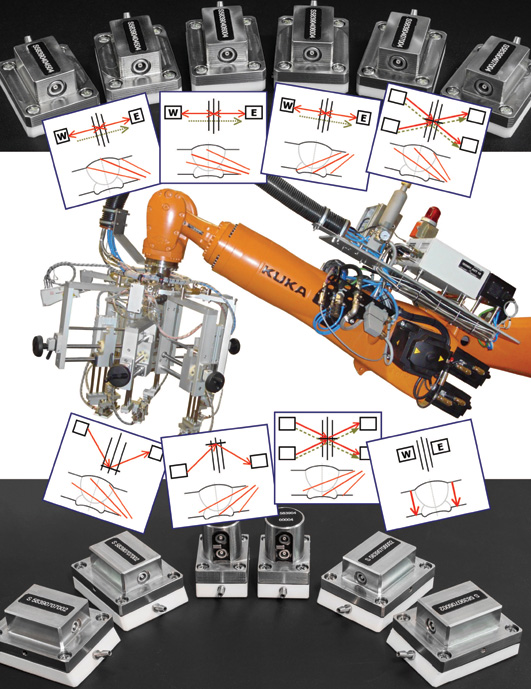
For the area scanning inspection data may be presented in a form combining amplitude / TOF / Thickness C-Scan, B- and D-Scan, 3D-View, etc. Significant increasing of scanning speed is provided through use of grape-, brush-, or other type of
composition of several probes driven each by it’s own channel into one inspection head
|
|
Raw data A-Scans are stored completely upon saving inspection results into a file and may be played-back and processed off-line then enabling echo-dynamic pattern analysis, defects sizing, outlining, pattern recognition. Inspection data may be converted into widely used ASCII, MS Excel, MS Access, MS Word formats
One regular PC may control and acquire data from several ISONIC AUT 16/32 instruments simultaneously allowing rational organization of AUT jobs on-site and minimizing manpower involved
Application Example:
Movie illustrating on-line automatic multi-channel full body inspection of spirally welded pipes
|
Download PDF Brochure - Acrobat Reader 9 is recommended
|
Technical Data (Typical)
| Number of Channels: |
16 - ISONIC AUT 16 32 - ISONIC AUT 32 |
| Pulsing/Receiving Methods: |
Parallel - all channels do fire, receive, digitize, and record signals simultaneously Sequential – cycles of firing, receiving, digitizing, and recording signals by each channel are separated in time in a sequence loop |
| Pulse Type: |
Bipolar Square Wave Pulse |
| Initial Transition: |
≤5 ns (10-90%) |
| Pulse Amplitude**: |
Smoothly tunable (12 levels) 75 V … 400 V peak to peak into 50 Ω |
| Pulse Duration*: |
50…600 ns for each half wave synchronously controllable in 10 ns step |
| Modes*: |
Single / Dual |
| PRF**: |
0 – optionally; 15...5000 Hz controllable in 1 Hz resolution |
| Optional Sync Output / Input**: |
Max +5V, τ ≤ 5 ns, t ≥100 ns, Load Impedance ≥ 50 Ω |
| Gain*: |
0...100 dB controllable in 0.5 dB resolution |
| Advanced Low Noise Design: |
81 μV peak to peak input referred to 80 dB gain / 25 MHz bandwidth |
| Frequency Band**: |
0.2 … 25 MHz Wide Band |
| A/D Conversion: |
Parallel 100 MHz 16 bit |
| Digital Filter*: |
32-Taps FIR band pass with lower and upper frequency limits controllable with 0.1 MHz resolution |
| Ultrasound Velocity*: |
300…20000 m/s (11.81…787.4 "/ms) controllable in 1 m/s (0.1 "/ms) resolution |
| Range*: |
0.5...7000 ms controllable in 0.01 ms resolution |
| Display Delay*: |
0...3200 μs controllable in 0.01 μs resolution |
| Probe Angle*: |
0…90° controllable in 1° resolution |
| Probe Delay*: |
0 to 70 μs controllable in 0.01 μs resolution - expandable |
| Display Modes*: |
RF, Rectified (Full Wave / Negative or Positive Half Wave), Signal's Spectrum (FFT Graph) |
| Reject*: |
0...99 % of screen height controllable in 1% resolution |
| DAC / TCG*: |
Theoretical – through keying in dB/mm (dB/") factor
Experimental – through sequential recording echo amplitudes from variously distanced equal reflectors
46 dB Dynamic Range, Slope ≤ 20 dB/ms, Capacity ≤ 40 points
Available for Rectified and RF Display |
| DGS*: |
Standard Library for 18 probes / unlimitedly expandable |
| Gates*: |
3 Independent Gates / unlimitedly expandable |
| Gate Start and Width*: |
Controllable over whole variety of A-Scan Display Delay and A-Scan Range in 0.1 mm /// 0.001" resolution |
| Gate Threshold*: |
5…95 % of A-Scan height controllable in 1 % resolution |
| Gate per Gain Correction*: |
Independently controllable for each gate in 26 dB range with 0.5 dB resolution |
Measuring Functions – Digital Display Readout*: |
27 automatic functions / expandable; Dual Ultrasound Velocity Measurement Mode for Multi-Layer Structures; Curved Surface / Thickness / Skip correction for angle beam probes; Ultrasound velocity and Probe Delay Auto-Calibration for all types of probes |
| Freeze (A-Scans and Spectrum Graphs)*: |
Freeze All – A-Scans and Spectrum Graphs / Freeze Peak – A-Scans / All measurements functions, manipulating Gates, and ±6dB Gain varying are available for frozen signals |
| Scanning Speed: |
20…100 mm/sec controllable in 1 mm/sec resolution |
| Encoder Interface: |
Built-in controller and interface for multi-axis incremental mechanical encoder |
| Encoding: |
Time-based (built-in real time clock – 0.02 sec resolution) – for line scanning only True-to-location (single-axis and multi-axis incremental mechanical encoder) – for line and area scanning |
| Imaging Modes: |
Strip Charts of 4 types (Amplitude/TOFD P/E, Map, TOFD, Coupling) Amplitude / TOF / Thickness C-Scan, B-Scan, D-Scan, 3D-View |
| Standard Length of one Straight Line Scanning record: |
50…20000 mm (2"…800"), automatic scrolling |
| Method of Record: |
Complete raw data recording |
| Region of Interest*: |
Controllable over entire Display Delay, Probe Delay, Range, Ultrasound Velocity and other appropriate channel settings |
| Off-Line Image Analysis: |
Recovery and play back of A-Scan sequence at various gain levels
Echo-dynamic pattern analysis
Defects sizing, outlining, pattern recognition
Converting Record into ASCII / MS Excel / MS Access / MS Word formats |
| Real Time Hardware Outputs: |
Up to 67/134 independent user programmable digital lines (+24V or +9V logic) for controlling audible alarm sirens, paint guns, GO/NO-GO parts sorters – ISONIC AUT 16/32
Up to 16/32 independent user programmable TOF /Amplitude proportional analogue output lines (0…5V) – ISONIC AUT 16/32 |
| Hardware Control Inputs: |
Up to 3 independent user programmable lines for pedal/button “Start/Stop Inspection” control |
| On-Board Computer: |
AMD LX 800 - 500MHz |
| Operating System: |
Windowsä XP embedded |
| RAM: |
512 Megabytes |
| Internal Flash Memory - Quasi HDD: |
4 Gigabytes |
| Interface: |
Ethernet |
| Scanner Motor Interface: |
DC powering / RS 232 control - stepped motor |
| Power: |
Mains - 100…240 VAC, 40…70 Hz, auto-switch |
| Housing: |
IP 67 rugged aluminum case |
| Dimensions: |
295x174x346mm (11.62"x6.85"x13.62") |
| Weight: |
5.910 kg (13.00 lbs) |
* - individually controllable per channel
** - common for all channels
|
Innovative Architecture
|
Conventional Windows XP or Vista remote computer controls ISONIC PA AUT Platform through Ethernet
|
|
|
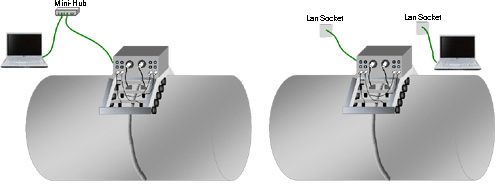
Connection to remote computer may be provided by means of Ethernet crossover cable, or through mini-hub or local network or Internet
|
|
Thanks to innovative architecture there is no need in bulky long umbilical for probes connection. Each probe is plugged
into appropriate socket of ISONIC PA AUT Platform using short cable – this significantly improves signal to noise ratio
and simplifies placing / removal of scanner or tractor onto / from object under test and scanning as well
ISONIC PA AUT Platform is available in various configurations combining 64, 128, or 256 channels for phased array probes and 0, 8, 16, or 32 channels for conventional probes, for example:
- ISONIC PA AUT 64/0 – 64 channels for phased array probes, no channels for conventional probes
- ISONIC PA AUT 128/8 – 128 channels for phased array probes, 8 channels for conventional probes
- ISONIC PA AUT 256/32 – 256 channels for phased array probes, 32 channels for conventional probes
- ect
ISONIC PA AUT Platform is free of overheating and does not require cooling circuit
|
Multiple Units Operation
Several ISONIC PA AUT platforms may be operated from one remote computer
|
|
|
Generic Software Package For Integrators and Users Creating Proprietary Inspection Applications:
Generic Software Package includes:
- IPA Service running in the on-board satellite computer of ISONIC PA AUT Platform and providing:
- execution of commands for managing electronics and scanner motors received from remote computer
- transmission of A-Scan and corresponding position encoder data to remote computer
- IPA SDK - software development kit for creating of application software including drivers for remote computer allowing:
- control of phased array and conventional channels
- control of motors
- receiving A-Scans
- receiving position encoder data
- Examples of source code utilizing drivers of IPA SDK are included into delivery package
Application Software Packages For Users Dealing With Practical Inspections
Each application software packages includes:
- IPA Service running in the on-board satellite computer of ISONIC PA AUT Platform and providing:
- execution of commands for managing electronics and scanner motors received from remote computer
- transmission of A-Scan and corresponding position encoder data to remote computer
- IPA SDK - software development kit for creating of application software including all necessary drivers for remote computer allowing:
- control of phased array and conventional channels
- control of motors
- receiving A-Scans
- receiving position encoder data
- IPA Application running in the remote computer and controlling ISONIC PA AUT Platform through IPA SDK, which provides:
- user interface for pre-scanning routine allowing defining of object under test and its shape and dimensions, setting probes data, selection of scanning strategy, etc
- user interface for control of phased array and conventional channels, scanner motors, receiving and indicating A-Scans and probe coordinates, inspection data presentation at pre-scanning calibration and trials stage
- user interface for performing scanning, data presentation during scanning, data storage and postprocessing
|
Example of Application SW Package – ASME 2235-9 Code Case Compatible Automatic Ultrasonic Inspection of Girth Welds
|
|
Pre-scanning Routine – Stage 1: Theoretical Setup Wizard
Theoretical Setup Wizard guides through:
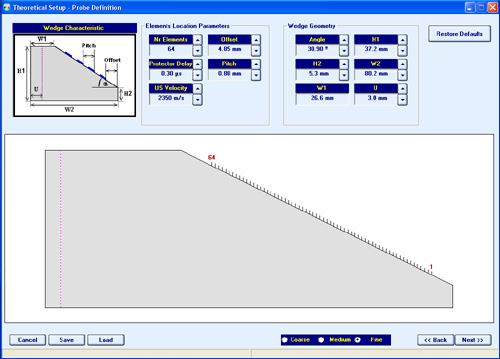
- Phased Array Probe Definition screen for keying in parameters of phased array probes and wedges, which are necessary for beam steering and focusing
|
|
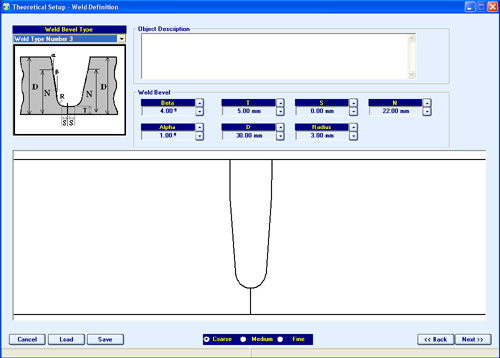
- Weld Definition screen for selection of appropriate weld bevel from data base and keying in related geometry and dimensions data
|
|
|
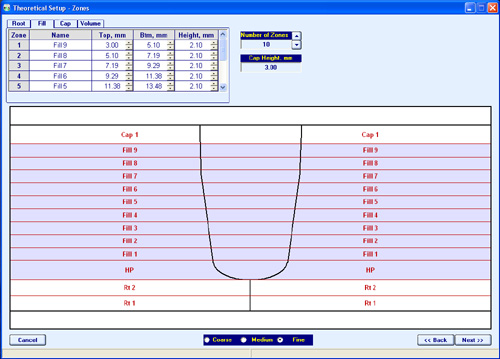
- Zones Definition screen for "slicing" of weld volume, cap, and root into zones to be insonified in each qualified position of phased array probe:
|
|
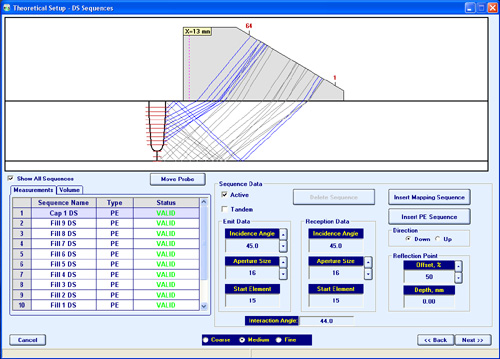
- Ray Tracing screen for determining of zone-by-zone insonification scheme (pulse echo or tandem; incidence angles; emitting and receiving aperture; focal distance) and appropriate positions for phased array probes from both sides of the weld
|
|
|
Theoretical Setup file is created upon completion of wizard as described and used for further setting of phased array channels
|
|
Pre-scanning Routine – Stage 2: Ultrasonic Setup Wizard
|
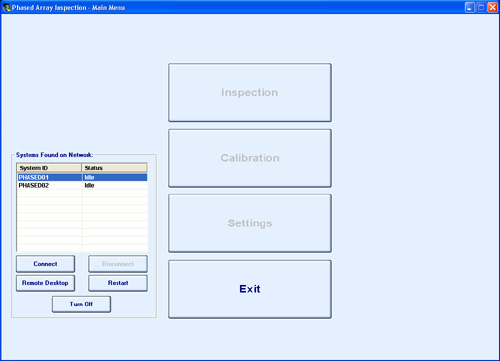
Ultrasonic Setup Wizard runs in the remote computer linked to ISONIC PA AUT Platform.
At that stage phased array, conventional pulse echo and TOFD probes connected to ISONIC PA AUT Platform
are manipulated over appropriate test blocks in order to provide settings ensuring detection of variously
located and oriented reference reflectors. Ultrasonic Setup Wizard guides through:
|
|
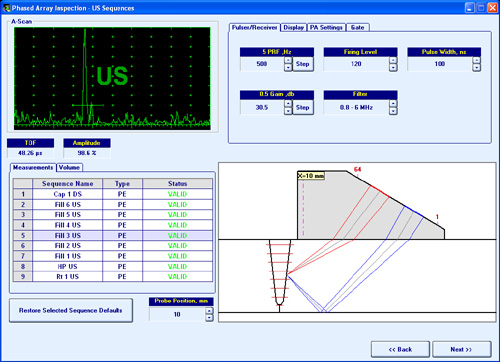
- Phased Array Settings screens for calibration of firing / receiving aperture and phasing, firing pulse amplitude and duration, gain, gates, etc. for each inspection zone designated for phased array probes located from both sides of the weld - downstream (DS) and upstream (US) positions
|
|
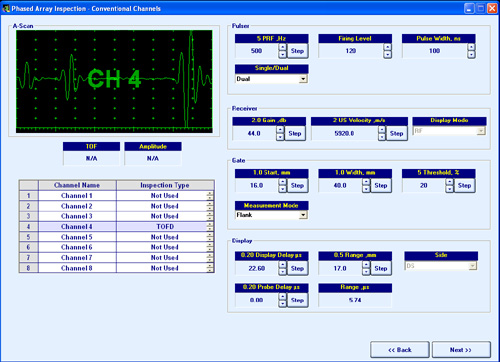
- Conventional and TOFD Probes Channels Settings screen for calibration of firing pulse amplitude and duration, gain, etc according to inspection schemes to be implemented
|
|
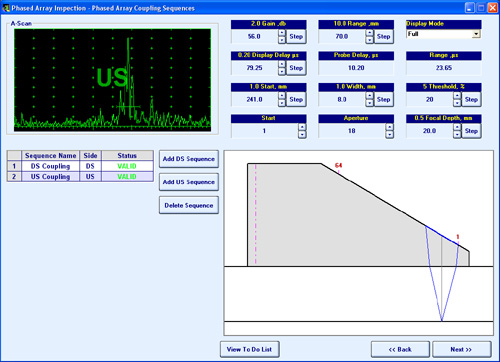
- Settings Coupling Monitors for Phased Array and Conventional Channels screens
|
|
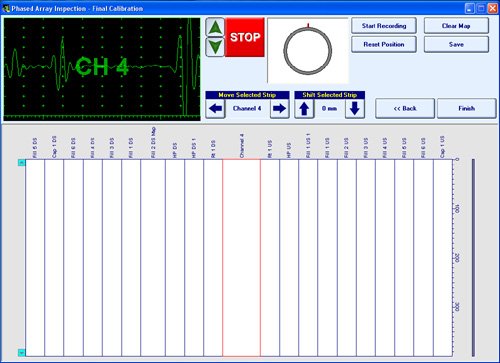
- Strip Chart Configuration screen for selecting horizontal position of each strip and vertical alignment of strips according to probes positioning along the weld. It is possible to perform scanning of calibration block with generating of reference strip chart record and further analysis of captured signals
|
|
Ultrasonic Setup Wizard is finished with creation of complete Inspection Setup File; inspection becomes possible at any moment after said file is uploaded into scanning routine
|
|
Scanning
|
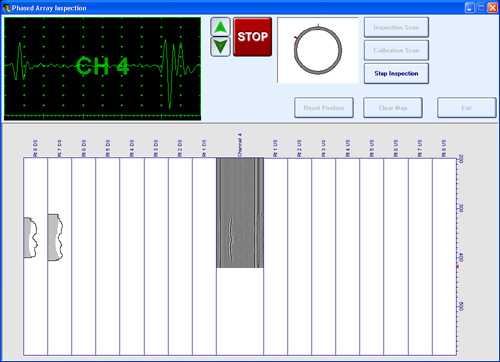
Whilst scanning the superimposed A-Scan data obtained by phased array probes for each zone and A-Scan data
captured by conventional pulse echo and TOFD probes is transferred to remote computer along with corresponding
coordinates. Remote computer provides on line raw data recording and strip chart imaging accompanied with
presentation of position of scanner on the weld. Operator may monitor live A-Scans for any strip. Inspection results file
compressing all raw data is created automatically on completion of scanning
|
|
|
Postprocessing
|
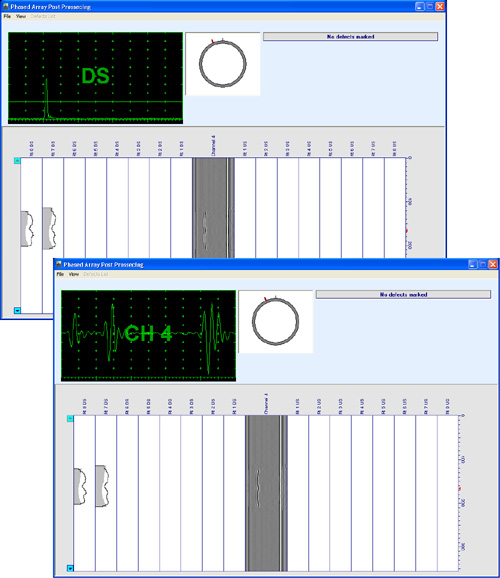
At postprocessing stage it is possible to play back all captured A-scan and to proceed with defects marking, sizing, and evaluation
|
|
|
Service Functions
|
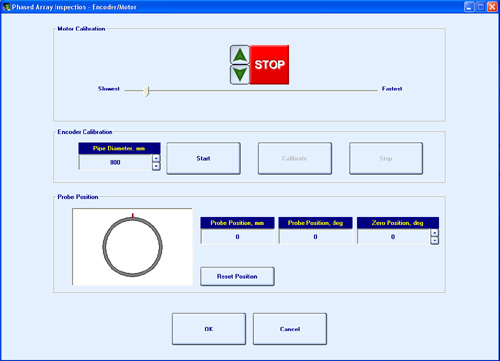
Motor setting and encoder calibration is performed in dialogue mode through simple user interface
|
|
|
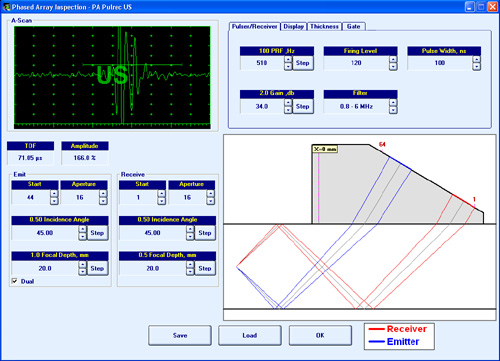
Each probe either phased array, conventional pulse echo, or TOFD may be driven independently through appropriate pulser receiver. This feature is very useful for various purposes such as verification of wedges, studying of phased array focusing effects, etc
|
|
|
|
|
|
|
|
|
|
|